

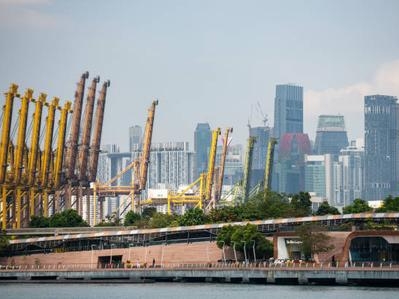
If you’ve ever visited a port in Singapore, you’ve likely been struck by the “giant hands” of industry—the towering, ceaselessly moving gantry cranes that handle endless streams of containers. But you may not know that Singapore is the world’s largest importer of overhead and gantry cranes, and behind that fact lies a closely connected “Made in China” story.
In 2024 alone, Singapore imported nearly US$3.5 billion worth of overhead traveling and gantry cranes. This not only made it the world’s number-one importer but also represented a staggering 34% year-on-year increase, with an average annual growth rate of nearly 20% over the past five years.
What’s even more interesting is that Singapore itself cannot produce most of these “iron giants,” resulting in a massive trade deficit of about US$3.25 billion. This means that Singapore functions more as a super-buyer and regional hub—its robust demand serves not only its own development but also fuels growth across Southeast Asia.
The numbers here are even more revealing: nearly 9 out of every 10 cranes entering Singapore are made in China.
In 2024, China exported over US$313 million worth of these cranes to Singapore, capturing a dominant 89.5% market share. This reliance is not new but a steadily growing trend: imports from China surged by 73% in just the last year.
Why is this the case?
Unbeatable “Cost-Effectiveness and Full-Service Capability”: China possesses the world’s most complete and largest crane manufacturing supply chain. From massive quayside cranes for ports to precision clean room cranes for pharmaceutical plants and explosion-proof cranes for chemical plants, China offers highly competitive products and one-stop solutions. From design and manufacturing to transportation, installation, and maintenance, the entire process is highly efficient.
Geographic “Next-Door Neighbor” Advantage: The close maritime distance between China and Singapore means lower and more convenient shipping costs. These massive structures can be transported modularly by sea. Crucially, many Chinese manufacturers have established service networks in Singapore, ensuring rapid after-sales response and technical support.
Catching the “Wave” of Regional Cooperation: Frameworks like the Belt and Road Initiative and regional free trade agreements have smoothed trade flows, allowing Chinese-made heavy equipment to enter and establish deep roots in the Southeast Asian market more easily.
Think cranes only work at the docks? Think again. In Singapore, these “iron giants” play critical roles across multiple industries:
Port Logistics (The Star Player): One of the world’s busiest ports, Singapore is building the Tuas Mega Port, a global benchmark in automation. Here, the demand is for fast and precise Automated Rail-Mounted Gantry Cranes (ARMGs) and ultra-strong Super-Post-Panamax quay cranes that operate 24/7, the absolute backbone of port operations.
Advanced Manufacturing (The Cleanroom Specialists): In Singapore’s booming biopharma and semiconductor fabs, where production environments must be pristine, specialized Clean Room Overhead Cranes take center stage. They are designed for precision and smooth operation, ensuring that multi-million-dollar equipment can be moved without introducing contamination.
Energy & Chemicals (The Safety Guardians): In the petrochemical plants on Jurong Island, the air may contain flammable gases. The cranes used here must be specially designed Explosion-Proof Cranes, with protected motors and electrical components to prevent sparks, acting as “iron guardians” of safety.
Urban Construction (The Sky-High Artisans): Behind Singapore’s ever-rising skyline are various tower cranes. They precisely hoist prefabricated modules hundreds of meters into the air, forming the “skeletal framework” of the city.
The cranes of the future are getting “smarter”:
Automation & Intelligence: More cranes are enabling remote control or even full autonomy. Operators can now direct port giants from the comfort of a control center.
Green Transformation: Electric and hybrid cranes are replacing traditional diesel-powered ones. Energy regeneration systems can convert the potential energy from lowering loads back into electricity, making operations more energy-efficient and eco-friendly.
Modular Design: Future cranes will be more like LEGO—easier and quicker to assemble, disassemble, and reconfigure for different tasks.
Singapore’s crane market is like a mirror. It reflects the prosperity of this city-state as a global hub and reveals the irreplaceable position of China’s advanced manufacturing within global supply chains. From ports to factories, from “Made in China” to “Applied in Singapore,” these “giant hands” do more than move cargo—they connect industries and opportunities, driving regional economic growth. The next time you see them, you might just hear the symphony of industry spanning the seas.
CONTACT
Be the first to know about our new product releases and latest news articles.Do you have any questions or requests?
Click below and we'll be happy to help. CONTACT