In 2014, China's independently designed and manufactured 22,000-ton gantry crane "Honghai" (MDGH22000t) with complete independent intellectual property rights was completed. It set a new world record as the largest giant gantry crane, filling the gap in China's ultra-large gantry crane sector. With a total lifting capacity of 22,000 tons, it established a new benchmark for heavy lifting equipment and pioneered an innovative model for offshore oil platform construction, showcasing China's high-end equipment manufacturing strength.
Core Parameters: Decoding the Strength of the "Behemoth"
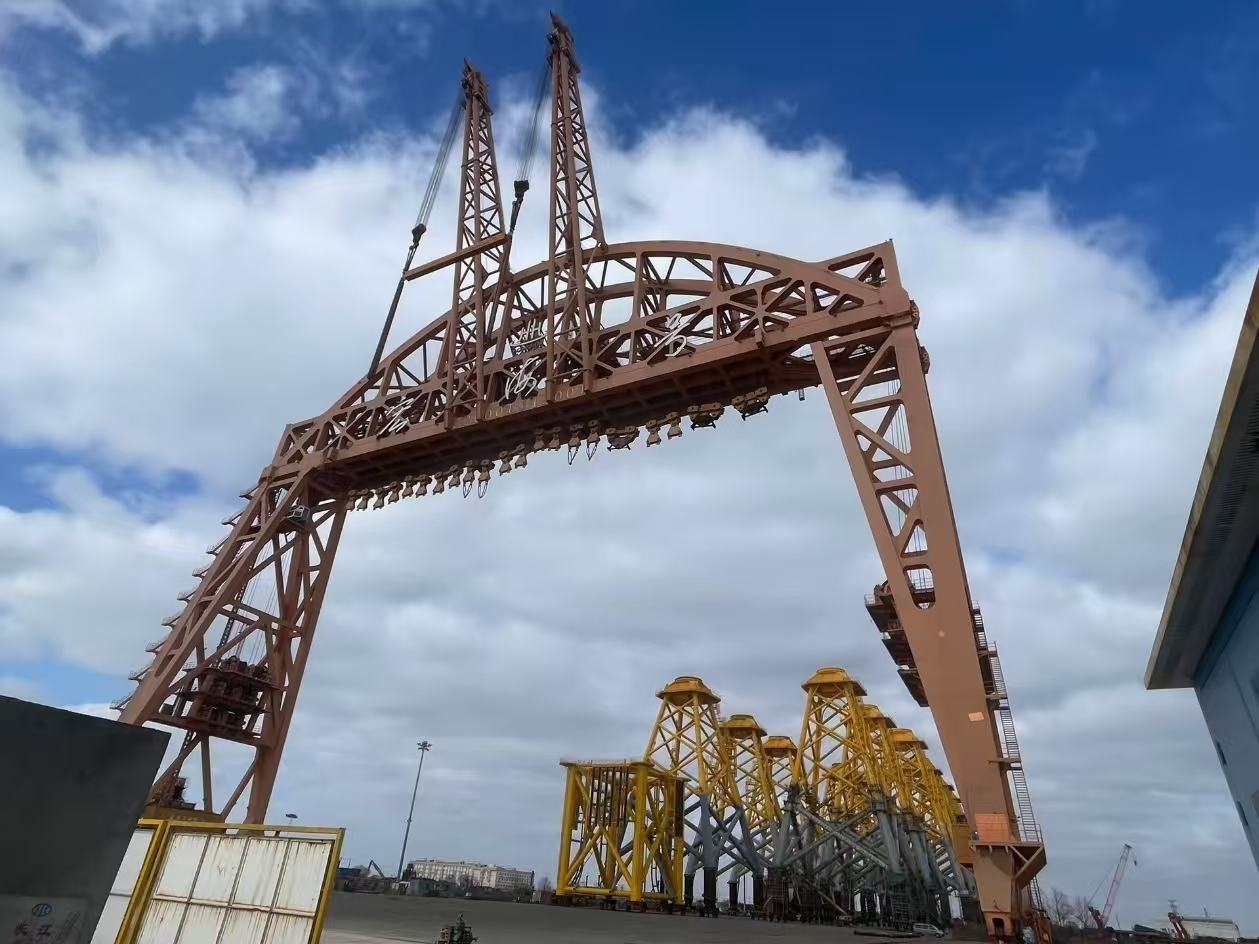
The "Honghai"'s size is reflected in impressive core parameters: its 22,000-ton lifting capacity—equivalent to 400 high-speed rail carriages and 11 times that of the previous global record-holder—makes it the pinnacle of heavy lifting. Measuring 148 meters tall (50-story building equivalent), 124.8 meters in span, and 71.38 meters in lifting height, it combines massive scale with precise operation.
A combined crane of two 11,000-ton units, it features 96 lifting points (48 per main beam) with 300-ton rated capacity each for uniform load distribution. Built with 11,000 tons of high-strength steel to support its 14,800-ton weight, it is equipped with 128 pairs of roller trolleys powered by an 1,800-kilowatt drive system, enabling 300-meter movement.
Its construction required substantial investment: a total cost of nearly 800 million yuan (main contract: ~370 million yuan). Its 46-meter-deep concrete foundation piles alone cost 300 million yuan, ensuring stable operation.
Technological Innovation: Breaking Conventional Structural and Control Wisdom
Beyond size, the "Honghai" boasts disruptive innovations. Its core truss and external arch design—composed of triangular nodes—enhances load capacity without increasing cross-section, reducing weight, costs, and wind resistance for excellent wind performance.
Key innovation is its asymmetric rigid-flexible leg structure: one rigid leg welded to the main beam, the other flexible via articulated joint, offsetting deformation and boosting stability. Both lattice-type trapezoidal truss legs connect to the support and traveling system for stable, precise movement.
It adopts a high-load, low-friction roller support system with 32 roller bogies per leg base, distributing load via hydraulic cylinders and disc joints. Variable-frequency motor-driven pinions mesh with rack rails for synchronous movement, enhanced by sensors and automatic control for precision.
Additionally, a PLC-based control system monitors operations in real time, enabling rapid fault diagnosis and emergency maintenance to ensure safety and extend service life.
Practical Application: Reshaping the Offshore Equipment Construction Model
Based at Honghua Qidong Offshore Equipment Base, it enables integrated lifting/launching of offshore oil platforms, pioneering the "onshore modular manufacturing + wharf assembly" model, which upgrades traditional construction comprehensively.
This model boosts efficiency: simultaneous onshore module construction, integral lifting, and support for 10 platforms per dock (breaking single-dock limits). It shortens cycles, reduces scattered lifting, and saves labor/equipment.
It optimizes costs by reducing reliance on expensive infrastructure (dry docks, semi-submersible barges) and environmental dependencies (weather, tides). Integral lifting improves alignment precision, structural integrity, and lowers maintenance costs.
Socio-Economic Value: Empowering Industrial Upgrading and International Competitiveness
The "Honghai" drives profound socio-economic impacts: creating 4,000-6,000 jobs and boosting local industries (manufacturing, logistics, maintenance, port services) to form an offshore equipment-focused cluster.
It enhances industrial competitiveness by delivering shorter cycles and higher returns, strengthening China's global offshore engineering market position. Critically, its independent intellectual property strengthens China's high-end offshore equipment capabilities, breaks foreign monopolies, and elevates international influence.
From design to application, the "Honghai" embodies China's equipment manufacturing innovation. It is a global heavy lifting benchmark and a vivid symbol of China's transformation from a manufacturing giant to a manufacturing power.